.png)
Cybersecurity Roadmap: Why It Is Essential for Managing Enterprise Risk Today
Because protecting the business starts with knowing where security is going, not just where it is today.
 ITSEC Asia
Introduction
Many organizations invest heavily in security tools, yet still struggle to explain their overall security posture. This is not always due to lack of technology, but often due to lack of direction.
As digital environments grow more complex, security decisions are made across cloud platforms, remote endpoints, third-party integrations, and increasingly, AI-driven systems. According to findings highlighted in the World Economic Forum, cyber risk today is less about a single vulnerability and more about how fragmented security efforts accumulate across interconnected environments.
Without a clear plan, security initiatives tend to be reactive. Controls are added in response to incidents, audits, or vendor recommendations, rather than as part of a coordinated strategy. This is where a Cybersecurity Roadmap becomes critical.
A roadmap provides a structured way to define priorities, sequence improvements, and align security with business risk. Industry guidance from NIST Cybersecurity Framework emphasizes that this approach enables organizations to move from isolated security actions toward a cohesive and resilient defense posture.
What Is a Cybersecurity Roadmap?
A Cybersecurity Roadmap is a strategic, phased plan that defines how an organization will improve its security posture over time. According to industry guidance from Gartner, a roadmap connects current security maturity with future objectives and helps prioritize investments based on business impact.
Unlike a static security policy, a roadmap is:
-
Dynamic, evolving with threat landscapes and technology changes
-
Business-aligned, mapped to organizational goals and critical assets
-
Measurable, with clear milestones and maturity indicators
In enterprise environments, a roadmap typically spans 12 to 36 months and integrates people, process, and technology initiatives into one coherent strategy. Insights from Gartner CISO Agenda identify this horizon as effective for balancing execution with long-term resilience.
Cybersecurity Roadmap vs. Security Strategy
Security leaders often use these terms interchangeably, but they serve different purposes.
A security strategy defines what the organization wants to achieve, such as reducing ransomware risk or achieving regulatory compliance.
A Cybersecurity Roadmap defines how and when those goals will be achieved.
In practical terms, the roadmap translates strategy into:
-
Sequenced initiatives
-
Budget-aligned projects
-
Clear ownership across IT, security, and business teams
This distinction is critical for executive buy-in, as boards and C-level leaders increasingly expect timelines, outcomes, and accountability rather than high-level vision statements.
The 5 C’s in Security: A Foundation for Roadmap Design
When organizations ask, “What are the 5 C’s in security?”, they are referring to a widely used conceptual framework that helps structure security priorities across enterprise environments.
The 5 C’s typically include:
-
Confidentiality (Protecting sensitive data from unauthorized access)
-
Compliance (Meeting legal, regulatory, and contractual obligations)
-
Continuity (Ensuring systems and services remain available during disruptions)
-
Control (Establishing governance, access management, and oversight)
-
Cyber Resilience (The ability to prevent, detect, respond to, and recover from attacks)
A mature Cybersecurity Roadmap aligns initiatives across all five dimensions, rather than over-investing in a single area such as perimeter defense or compliance checklists.
Key Components of an Effective Cybersecurity Roadmap
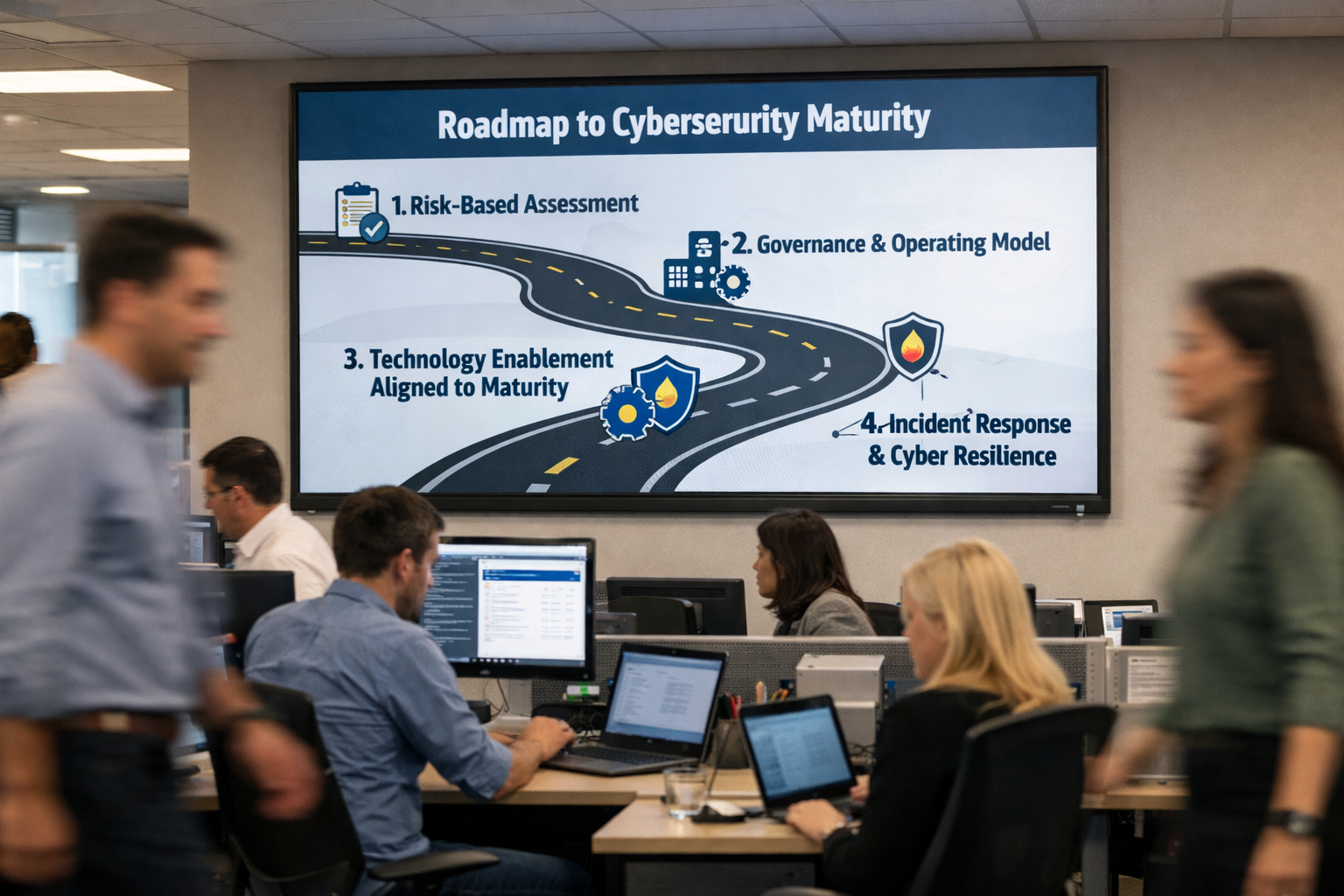
1. Risk-Based Assessment
Effective roadmaps begin with understanding critical business processes, high-value assets, and likely threat scenarios. Industry risk analysis published in Verizon Data Breach Investigations Report (DBIR) mentioned that attackers consistently exploit assets with the highest business impact and weakest oversight.
2. Governance and Operating Model
Strong governance defines ownership, decision-making authority, and reporting lines. Guidance from Gartner shows that clear operating models improve execution and accountability.
3. Technology Enablement Aligned to Maturity
Rather than deploying tools indiscriminately, mature roadmaps align technology with capability gaps. According to findings highlighted in Gartner security platform convergence and tool rationalization research, enterprises increasingly prioritize integration over point solutions.
4. Incident Response and Cyber Resilience
In enterprise environments, incidents are inevitable. Insights from CrowdStrike Global Threat Report and Mandiant incident response analysis emphasize the importance of tested response plans, recovery alignment, and continuous improvement.
Why This Matters for Businesses Today
Cybersecurity is no longer an isolated IT concern. It has become a core business function that directly influences organizational resilience, regulatory standing, and long-term growth.
A well-defined Cybersecurity Roadmap helps organizations maintain business continuity by reducing downtime and limiting operational disruption during security incidents. It also supports regulatory compliance by providing structured, auditable controls that align with evolving legal and industry requirements. From an operational perspective, a roadmap improves efficiency by reducing tool sprawl, minimizing manual processes, and ensuring that security investments are coordinated rather than fragmented.
Security leaders are increasingly realizing that organizations without a roadmap struggle to justify budgets or demonstrate progress. Findings highlighted in Gartner indicate that reactive security lacks measurable business value.
In contrast, organizations that operate with a defined Cybersecurity Roadmap are better positioned to adapt to AI adoption, regulatory change, and an evolving threat landscape with confidence. By aligning security initiatives with enterprise risk appetite and business priorities, these organizations can approach cybersecurity as a strategic capability rather than a reactive cost.
Turning Strategy into Action
A roadmap is only valuable if it is actively used. According to industry guidance, effective roadmaps are:
-
Reviewed and updated regularly
-
Used to guide budgeting and investment decisions
-
Integrated with security operations and risk management
-
Communicated across technical and non-technical stakeholders
In practice, this turns cybersecurity from a reactive function into a strategic capability.
At ITSEC, advisory engagements often focus on helping organizations assess their current security posture and translate complex risks into clear, actionable roadmaps that support long-term resilience and informed decision-making.