.png)
How AI Helps Reduce False Positives in Security Assessments
Finding Vulnerabilities Is Important. Finding the Right Ones Is Even More Important.
 ITSEC Asia
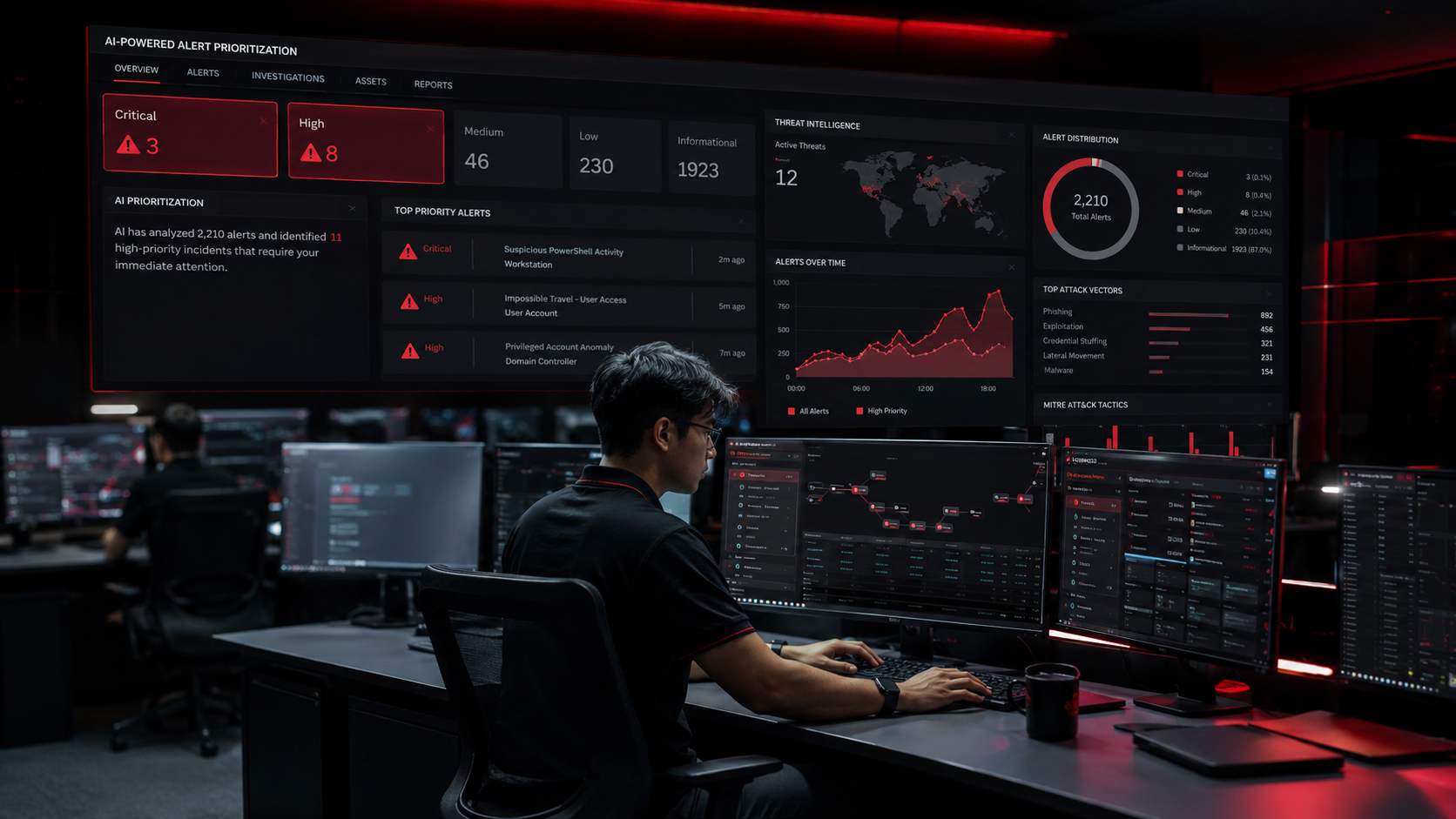
Modern security teams are drowning in alerts.
Vulnerability scanners, SIEM platforms, threat detection tools and security assessments generate thousands of findings every day. While visibility is essential, not every finding represents a genuine threat.
Many turn out to be false positives.
As organizations expand their attack surfaces and adopt increasingly complex environments, managing false positives has become one of the biggest operational challenges in cybersecurity.
Because ultimately, cybersecurity is not about generating more alerts.
It is about identifying the risks that truly matter.
What Are False Positives in Cybersecurity?
A false positive occurs when a security tool or assessment identifies something as a vulnerability or threat, even though it poses little or no actual risk.
In other words, a finding appears dangerous but cannot realistically be exploited or does not have meaningful impact.
False positives can originate from:
- Vulnerability scanners.
- Automated security assessments.
- Threat detection systems.
- SIEM platforms.
- Security monitoring tools.
- Misconfigured rules and signatures.
Although these tools are designed to maximize detection, excessive false positives often create new problems.
Why Are False Positives a Problem?
At first glance, receiving more alerts may seem safer.
In reality, too much noise can weaken security operations.
Alert Fatigue
Security analysts are constantly bombarded with notifications.
When too many findings turn out to be irrelevant, teams can become overwhelmed and may eventually overlook genuinely critical issues.
Slower Remediation
Time spent investigating non-existent risks means less time addressing vulnerabilities that actually matter.
This can delay remediation efforts and increase exposure.
Reduced Confidence
If tools repeatedly produce inaccurate results, security teams may begin to lose confidence in their findings.
Over time, this can lead to important warnings being ignored.
Resource Constraints
Cybersecurity talent remains scarce.
Highly skilled professionals should focus on strategic analysis and complex attack scenarios, not spend countless hours validating low-value findings.
Why Traditional Approaches Often Generate False Positives
Most vulnerability scanners are designed with one goal in mind:
Find as many weaknesses as possible.
This approach prioritizes detection over context.
As a result, organizations may encounter:
- Duplicate findings.
- Incorrect severity classifications.
- Vulnerabilities that cannot actually be exploited.
- Risks that are irrelevant to the environment.
- Alerts without business context.
Finding a vulnerability does not automatically mean it represents a meaningful threat.
Context matters.
How AI Helps Reduce False Positives
Artificial Intelligence introduces a more intelligent approach to security assessments.
Instead of simply producing larger volumes of findings, AI helps security teams prioritize and validate what truly matters.
Adding Context to Findings
AI can analyze vulnerabilities within the broader context of the environment.
Factors such as:
- Asset criticality.
- Exposure.
- Attack paths.
- Existing controls.
- Relationships between systems.
help determine whether a vulnerability represents an actual risk.
Intelligent Prioritization
Not every vulnerability deserves immediate attention.
AI can help prioritize findings based on:
- Likelihood of exploitation.
- Potential business impact.
- Environmental context.
- Severity and exposure.
This enables organizations to focus on the issues that present the greatest risk.
Correlating Information Across Multiple Sources
Modern environments generate data from many different systems.
AI can correlate information across multiple sources to provide a clearer picture of security posture and eliminate unnecessary noise.
Supporting Continuous Validation
Environments evolve continuously.
AI enables organizations to validate findings more dynamically and maintain visibility as risks change over time.
AI Does Not Eliminate the Need for Human Expertise
Artificial Intelligence improves efficiency, but cybersecurity remains a human discipline.
Experienced security professionals provide:
- Business context.
- Creative attacker thinking.
- Strategic decision-making.
- Validation of complex attack scenarios.
Human expertise ensures that findings are accurate, meaningful and actionable.
AI accelerates the process.
Together, Human + AI delivers better outcomes.
Why Reducing False Positives Matters
Reducing false positives helps organizations:
- Improve operational efficiency.
- Reduce alert fatigue.
- Accelerate remediation efforts.
- Increase confidence in findings.
- Optimize limited security resources.
- Strengthen cyber resilience.
The goal is not to eliminate alerts.
The goal is to improve the quality of insights.
Continuous Security Validation Brings Greater Confidence
Security is not static.
New vulnerabilities emerge. Systems evolve. Attack surfaces expand.
Continuous Security Validation enables organizations to continuously verify whether findings represent actual risks rather than relying solely on periodic assessments.
Combined with AI-driven analysis, organizations can maintain visibility while reducing unnecessary noise.
Human + AI Is the Future of Offensive Security
The future of cybersecurity is not about replacing humans with machines.
AI provides:
- Speed.
- Automation.
- Scalability.
- Continuous visibility.
Humans provide:
- Experience.
- Creativity.
- Context.
- Strategic judgment.
Together, Human + AI enables organizations to make better decisions and build more resilient security programs.
Conclusion
False positives have long been one of the biggest challenges facing security teams.
While traditional tools excel at detection, AI introduces greater context, prioritization and continuous validation.
Technology alone, however, is not enough.
The future of offensive security lies in combining the strengths of AI with the expertise of cybersecurity professionals.
Because better security is not about seeing more.
It is about understanding what truly matters.
Explore Bronyx
Bronyx is an AI-powered autonomous penetration testing platform developed by ITSEC Asia. Built around a Human + AI philosophy, Bronyx helps organizations continuously validate their security posture, reduce blind spots and improve the accuracy of security findings.
By combining intelligent automation with human expertise, Bronyx enables organizations to move beyond point-in-time assessments and adopt a more sustainable approach to offensive security.
👉 Learn more about Bronyx: https://bronyx.ai
Need Expert-Led Security Assessments?
Technology can improve efficiency, but experienced professionals remain essential for understanding business context and validating complex attack scenarios.
ITSEC Asia is a CREST-accredited cybersecurity company trusted by enterprises and government organizations across Southeast Asia. Our experts provide:
- Penetration Testing
- Vulnerability Assessments
- Red Team Assessments
- Web Application Security Testing
- API Security Testing
- Cybersecurity Consulting
Combining deep expertise with innovative technologies, we help organizations improve visibility and strengthen cyber resilience.
👉 Explore ITSEC Asia's cybersecurity services: https://itsec.asia