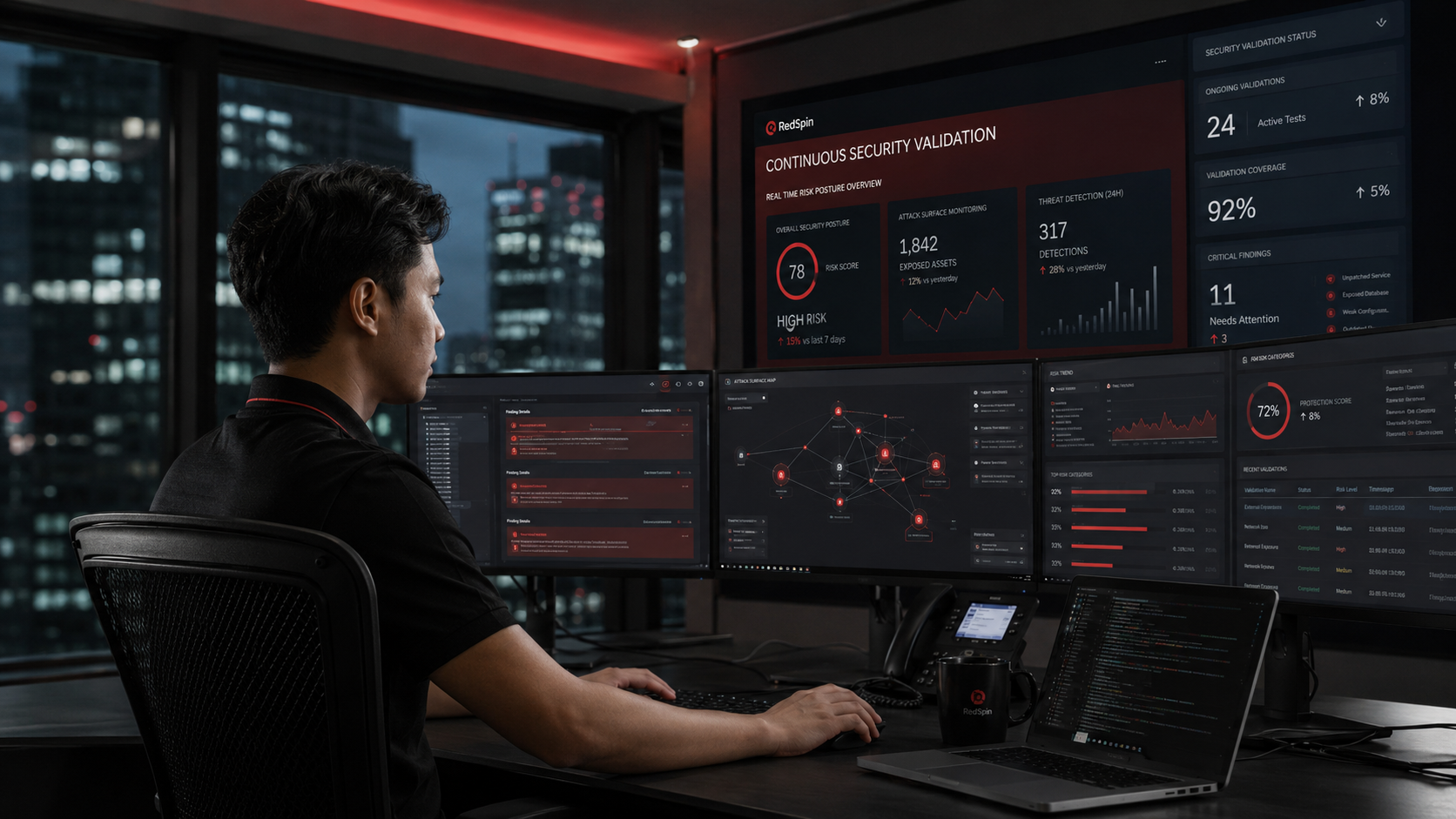
.png)
What Makes AI-Powered Penetration Testing Different From Automated Scanners?
AI-powered penetration testing does more than automated scanners ever could. ITSEC Asia, Indonesia's leading cybersecurity company, explains the real difference and why it matters.
 ITSEC Asia
Introduction
How much of what a vulnerability scanner flags every week actually turns out to be real? Research from OWASP puts the false positive rate for common vulnerability types somewhere between 15% and 30%, and separate research from Snyk found that security teams now spend roughly 70% of their time chasing alerts that end up being nothing at all. That gap between what a tool reports and what is actually exploitable is not a minor inconvenience. It is the reason a third of companies surveyed admitted they responded late to a genuine attack because their team was buried in phantom threats instead. ITSEC Asia, Indonesia's leading cybersecurity company, works with organizations across the region that have learned this the hard way, and the question that keeps coming up is simple. If a scanner already checks the boxes, why does AI-powered penetration testing exist at all, and what does it actually do differently?
Source: OWASP false positive research via DEV Community · Snyk: Minimizing False Positives
The Fundamental Difference: Following Rules Versus Reasoning Like an Attacker
An automated scanner works by matching what it sees against a library of known patterns. It checks a version number against a list of disclosed vulnerabilities, tests a form field against a set of known injection payloads, or confirms that an endpoint responds when it should not. That process is fast and useful for catching obvious, well-documented issues at scale, but it stops at the surface.
Traditional automated scanners:
-
Match findings against known vulnerability signatures and predefined rules.
-
Detect common issues such as outdated software versions, known injection payloads, or exposed endpoints.
-
Operate quickly and efficiently for large-scale vulnerability assessments.
-
Evaluate findings individually without understanding their broader context.
-
Cannot reason through complex attack paths, such as testing whether one authenticated user can access another user's data (e.g., Broken Access Control or IDOR).
AI-powered penetration testing:
-
Mimics how a human attacker thinks by forming hypotheses, testing them, and adapting based on results.
-
Performs reconnaissance, threat modeling, exploitation, vulnerability chaining, and validation as part of a continuous workflow.
-
Combines multiple findings to identify realistic attack paths rather than treating each issue separately.
-
Validates vulnerabilities by attempting controlled exploitation, reducing theoretical findings and highlighting confirmed business risks.
-
Focuses on contextual reasoning instead of relying solely on predefined signatures
Source: Why Automated Scanners Miss Real Vulnerabilities · Autonomous AI Agents for Penetration Testing: A Complete Guide
Why the Gap Shows Up in Real Security Outcomes, Not Just in Theory
The scale of modern cybersecurity has outpaced what traditional scanners were designed to handle. More than 48,000 new CVEs were published in 2025, averaging approximately 131 new vulnerabilities every day. As attack surfaces continue to expand, organizations increasingly face vulnerabilities that require contextual reasoning rather than simple pattern matching.
Why traditional scanners struggle:
-
Cannot realistically keep pace with the growing number of newly disclosed vulnerabilities.
-
Frequently miss logic flaws, broken access controls, and multi-step attack chains.
-
Generate large numbers of false positives that increase security teams' workload.
-
Encourage alert fatigue, making analysts less likely to trust or thoroughly investigate scanner results.
How AI-powered penetration testing improves outcomes:
-
Uses contextual reasoning to detect vulnerabilities that depend on application logic.
-
Validates exploitability before reporting findings, significantly reducing false positives.
-
Produces actionable, verified security issues instead of theoretical risks.
-
Enables security teams to prioritize remediation more efficiently and respond faster to genuine threats.
Source: Software Vulnerability Statistics 2026 · Aikido: AI Penetration Testing
How This Plays Out in Practice With a Human and AI Approach
The organizations getting the most value out of this shift are not the ones replacing people with AI entirely. The pattern across the industry in 2026 is consistent: autonomous systems own breadth, speed, and continuous coverage, while human experts own final validation, judgment calls on business impact, and sign off on what actually goes into a report a regulator or board will read. That balance is exactly how Bronyx, ITSEC Asia's AI-powered continuous penetration testing platform, is built. Bronyx runs assessments continuously across an organization's full attack surface rather than on an annual cycle, uses AI to reason through and chain findings the way a real attacker would, and then routes every confirmed result through human expert review before it becomes part of a client's official record. The result is a stream of audit-ready, timestamped documentation that shows not just what was found, but what was actually proven exploitable and what was fixed, which is the kind of evidence regulators and accreditation bodies increasingly expect rather than simply hope for.
ITSEC Asia has spent more than a decade helping organizations across Indonesia, Singapore, Australia, and the UAE move past the false sense of security that a clean scan report can create, and the shift toward AI-powered, human-validated testing is the clearest example yet of what that maturity actually looks like in practice.
Source: Autonomous AI Agents for Penetration Testing · AI Pentesting Agents 2026
See the Difference on Your Own Systems
A scanner can tell an organization what might be wrong. Only testing that reasons, chains, and validates like a real attacker can tell them what is actually exploitable, and that difference is what ends up in a regulator's report after an incident.
Visit bronyx.ai to see how continuous, AI-powered penetration testing works, or reach the ITSEC Asia team directly at itsec.asia/contact to talk through what this looks like for your environment.